



Chloride Channel
Cl− Channels
Chloride channels belong to a superfamily of ion channels that permit passive passage of anions, mainly chloride, across cell membrane. Chloride channels perform important roles in the regulation of cellular excitability, in transepithelial transport, cell volume regulation, and acidification of intracellular organelles. Chloride channels represent a group of potential drug targets.
The chloride channel protein (ClC) family comprises both chloride (Cl-) channels and chloride/proton (Cl-/H+) antiporters. In prokaryotes and eukaryotes, these proteins mediate the movement of Cl- ions across the membrane. In eukaryotes, ClC proteins play a role in the stabilization of membrane potential, epithelial ion transport, hippocampal neuroprotection, cardiac pacemaker activity and vesicular acidification.
All Product Categories
-
Chloride Channel Related Products (125)
Related Products (125)

-
Antibodies (3)
-
Talniflumate (Standard)
 0 ImagesSynonyms: BA 7602-06 (Standard)Talniflumate (Standard) is the analytical standard of Talniflumate. This product is intended for research and analytical applications. Talniflumate (BA 7602-06) is the proagent of Niflumic acid (HY-B0493), exerting its activity in the body through conversion to niflumic acid by esterase. Talniflumate is an orally active Ca2+-activated Cl- channel (CaCC) blocker. Talniflumate can be used as an analgesic and anti-inflammatory agent in cystic fibrosis mouse model of distal intestinal obstructive syndrome.
-
Picrotoxinin (Standard)
 0 ImagesCat. No.: HY-B1494RCAS No.: 17617-45-7Picrotoxinin (Standard) is the analytical standard of Picrotoxinin. This product is intended for research and analytical applications. Picrotoxinin, a potent convulsant, is a chloride channel blocker. Picrotoxinin is a noncompetitive GABAA receptor antagonist, which negatively modulates the action of GABA on GABAA receptors. Picrotoxinin inhibits α1β2γ2L GABAA receptor with an IC50 of 1.15 μM.
-
Flufenamic acid (Standard)
 0 ImagesFlufenamic acid (Standard) is the analytical standard of Flufenamic acid. This product is intended for research and analytical applications. Flufenamic acid is a non-steroidal anti-inflammatory agent, inhibits cyclooxygenase (COX), activates AMPK, and also modulates ion channels, blocking chloride channels and L-type Ca2+ channels, modulating non-selective cation channels (NSC), activating K+ channels. Flufenamic acid binds to the central pocket of TEAD2 YBD and inhibits both TEAD function and TEAD-YAP-dependent processes, such as cell migration and proliferation.
-
Adjudin (Standard)
 0 ImagesCat. No.: HY-18996RCAS No.: 252025-52-8Synonyms: AF-2364 (Standard)Adjudin (Standard) is the analytical standard of Adjudin. This product is intended for research and analytical applications. Adjudin is an extensively studied male contraceptive with a superior mitochondria-inhibitory effect. Adjudin is also a potent Cl- channel blocker.
-
Phenyl benzoate (Standard)
 0 ImagesPhenyl benzoate (Standard) is the analytical standard of Phenyl benzoate. This product is intended for research and analytical applications. Phenyl benzoate is a benzoate ester obtained by the formal condensation of phenol with benzoic acid. Phenyl benzoate is a chloride transport blocker, inhibits Cl--dependent Glu accumulation into vesicles. Phenyl benzoate can be used as preservative in cosmetic products.
-
Lubiprostone (Standard)
 0 ImagesCat. No.: HY-B0679RCAS No.: 136790-76-6Synonyms: RU-0211 (Standard); SPI-0211 (Standard)Lubiprostone (Standard) is the analytical standard of Lubiprostone. This product is intended for research and analytical applications. Lubiprostone (SPI-0211) increases intestinal fluid secretion through generation of CIC-2/CFTR and activation of cAMP signaling pathway. Lubiprostone inhibits myeloperoxidase (MPO) activity, downregulates Indomethacin (HY-14397)-induced iNOS and TNFα expression. Lubiprostone can be used for chronic constipation research.
-
Steviol (Standard)
 0 ImagesSteviol (Standard) is the analytical standard of Steviol (HY-N2057). This product is intended for research and analytical applications. Steviol is the main metabolite of steviol glycosides and an inhibitor of AQP2/CFTR. Steviol slows down the growth of renal cysts by inhibiting the activity of CFTR, reducing the expression of AQP2, and promoting the degradation of AQP2 and CFTR. Steviol can be used in the research of polycystic kidney disease.
-
Alilusem potassium
 0 ImagesCat. No.: HY-118233CAS No.: 114417-20-8Synonyms: M 17055Alilusem potassium is a diuretic. In anesthetized dogs undergoing water diuresis, Alilusem potassium effectively decreased free water clearance and increased Na+ and Cl- levels in excreted urine. When combined with Furosemide (HY-B0135) or Hydrochlorothiazid, Alilusem potassium further inhibited free water clearance. Alilusem potassium inhibited the lumen-positive transepithelial voltage and lumen-to-cistern Cl- flux in isolated rabbit cortical thick ascending limbs of Henle.
-
Niflumic Acid-d5
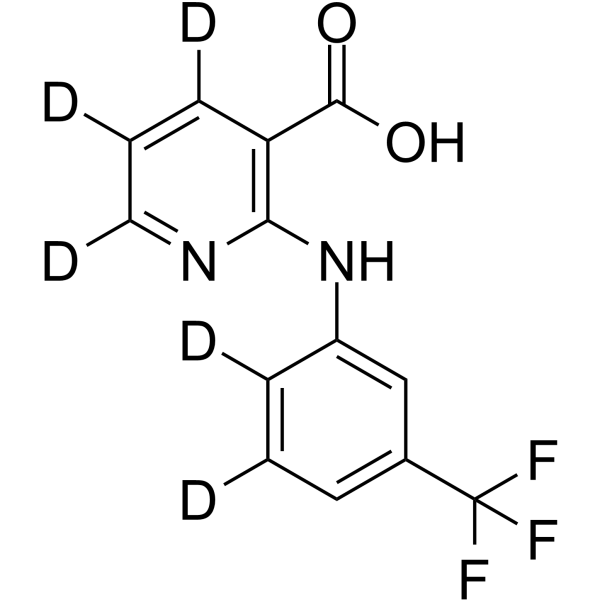 0 ImagesCat. No.: HY-B0493SCAS No.: 1794811-58-7Niflumic Acid-d5 is the deuterium labeled Niflumic acid. Niflumic acid, a Ca2+-activated Cl- channel blocker, is an analgesic and anti-inflammatory agent used in the treatment of rheumatoid arthritis.
-
Emidurdar (Standard)
 0 ImagesCat. No.: HY-105917RCAS No.: 265646-85-3Synonyms: Endovion (Standard); NS3728 (Standard)Emidurdar (Standard) is the analytical standard of Emidurdar (HY-105917). This product is intended for research and analytical applications. Endovion is a pharmacological anion channel inhibitor (like chloride channel) and the specific VRAC/VSOAC blocker. Endovion (NS3728) is also an Anoctamin-1 (ANO 1) channel inhibitor.
-
Hydroflumethiazide (Standard)
 0 ImagesCat. No.: HY-W011240RCAS No.: 135-09-1Synonyms: Methforylthiazidine (Standard); Rontyl (Standard)Hydroflumethiazide (Standard) is the analytical standard of Hydroflumethiazide. This product is intended for research and analytical applications. Hydroflumethiazide (Methforylthiazidine) is an orally active and potent thiazide diuretic. Hydroflumethiazide possesses the ability to directly stimulate A cell secretion in the normal and alloxan diabetic pancreas.
-
PGD97
 0 ImagesCat. No.: HY-P10226CAS No.: 2717490-36-1PGD97 is a selective cyclic peptide inhibitor against CAL/CFTR interactions, with a KD value of 6 nM towards the CAL PDZ domain for its desulfide cyclized form. PGD97 (desulfide cyclized form) has selectivity ≥ 130-fold compared to NHERF1/2 PDZ domains. PGD97 is capable of stabilizing F508del-CFTR at the cell membrane and improving CFTR function required for proper fluid homeostasis in tne lung. PGD97 can be used for the research of cystic fibrosis.
-
CaCCinh-A01 (Standard)
 0 ImagesCat. No.: HY-100611RCAS No.: 407587-33-1CaCCinh-A01 (Standard) is the analytical standard of CaCCinh-A01 (HY-100611). This product is intended for research and analytical applications. CaCCinh-A01 is an inhibitor of both TMEM16A and calcium-activated chloride channel (CaCC) with IC50s of 2.1 and 10 μM, respectively.
-
Eact (Standard)
 0 ImagesCat. No.: HY-103368RCAS No.: 461000-66-8Eact (Standard) is the analytical standard of Eact (HY-103368). This product is intended for research and analytical applications. Eact is a selective and potent activator of TMEM16A, directly activates the TRPV1 channels in sensory nociceptors and produces itch, acute nociception and thermal hypersensitivity.
-
Stepronin (Standard)
 0 ImagesSynonyms: Prostenoglycine (Standard); TTPG (Standard); Tiase (Standard)Stepronin (Standard) is the analytical standard of Stepronin. This product is intended for research and analytical applications. Stepronin (Prostenoglycine) is an orally active expectorant (inhalation administration is preferable to oral administration). Stepronin inhibits airway secretion in vitro by reducing Cl- secretion from epithelial cells and mucus glycoprotein secretion from submucosal glands.
-
Lubiprostone-d7
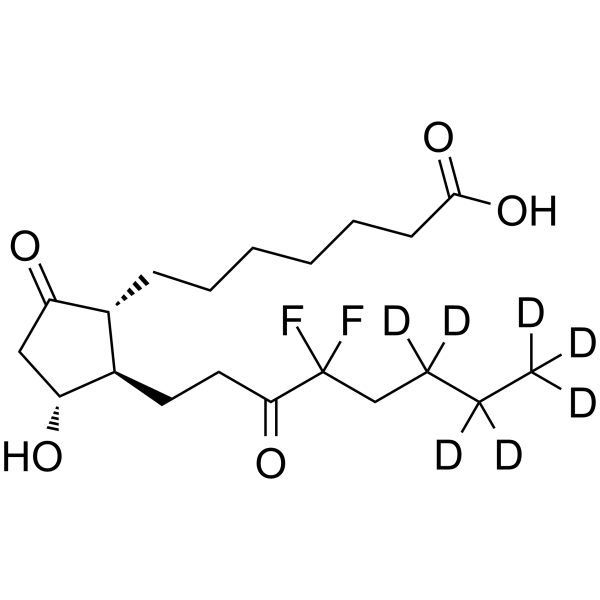 0 ImagesCat. No.: HY-B0679SCAS No.: 1217675-13-2Synonyms: RU-0211-d7; SPI-0211-d7Lubiprostone-d7 (RU-0211-d7) is the deuterium labeled Lubiprostone. Lubiprostone (SPI-0211) increases intestinal fluid secretion through generation of CIC-2/CFTR and activation of cAMP signaling pathway. Lubiprostone inhibits myeloperoxidase (MPO) activity, downregulates Indomethacin (HY-14397)-induced iNOS and TNFα expression. Lubiprostone can be used for chronic constipation research.
-
DCPIB (Standard)
 0 ImagesCat. No.: HY-103371RCAS No.: 82749-70-0DCPIB (Standard) is the analytical standard of DCPIB (HY-103371). This product is intended for research and analytical applications. DCPIB is a selective, reversible and potent inhibitor of volume-regulated anion channels (VRAC). DCPIB voltage-dependently activates potassium channels TREK1 and TRAAK, and inhibits TRESK, TASK1 and TASK3 (IC50s: 0.14, 0.95, 50.72 μM, respectively). DCPIB is also a selective blocker of swelling-induced chloride current (ICl,swell), with an IC50 of 4.1 μM. DCPIB is a useful tool for investigating structure-function studies of K2P channels.
-
T16Ainh-A01 (Standard)
 0 ImagesCat. No.: HY-100612RCAS No.: 552309-42-9T16Ainh-A01 (Standard) is the analytical standard of T16Ainh-A01 (HY-100612). This product is intended for research and analytical applications. T16Ainh-A01, an aminophenylthiazole, is a potent transmembrane protein 16A (TMEM16A) inhibitor, inhibiting TMEM16A-mediated chloride currents with an IC50 value of ~1 μM. TMEM16A (ANO1) functions as a calcium-activated chloride channel (CaCC).
-
Anthracene-9-carboxylic acid (Standard)
 0 ImagesSynonyms: 9-Anthracenecarboxylic acid (Standard)Anthracene-9-carboxylic acid (Standard) is the analytical standard of Anthracene-9-carboxylic acid. This product is intended for research and analytical applications. Anthracene-9-carboxylic acid (9-Anthracenecarboxylic acid) is an anthracene derivative traditionally used to block and identify Ca2+-activated Cl- currents (CaCCs) in various cell types, like diverse smooth muscle cells, epithelial cells and salivary gland cells.
-
BTS 39542
 0 ImagesCat. No.: HY-126038CAS No.: 57410-31-8BTS 39542 is an orally active inhibitor for Na+ K+ Cl cotransport system, that exhibits diuretic activity, and can be used in hypertension and edema research.




